
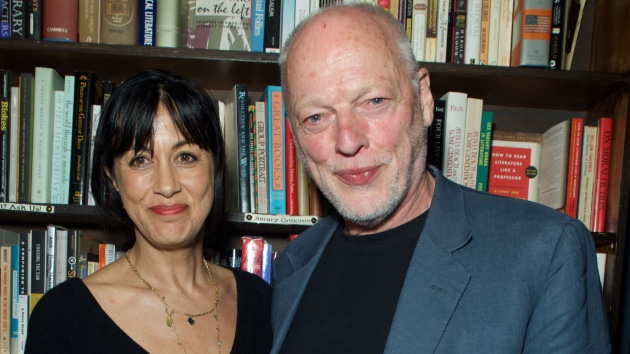
David Gilmour’s creative partnership with wife Polly Samson represents one of rock music’s most productive collaborative marriages, recently culminating in a photographic chronicle that documents the recording and performance of his latest album. Their relationship extends beyond personal partnership into professional territory where Samson’s literary skills have directly shaped Gilmour’s solo trajectory and helped him navigate the closure of Pink Floyd.
Samson is working on an exhibition of her work with Leica Gallery, building on her recent book “Luck and Strange Studio/Live,” published by Thames & Hudson in October 2025. The volume offers an intimate photographic record of Gilmour’s fifth solo album, capturing recording sessions, rehearsals, and live performances with unprecedented access. This project illustrates how their partnership functions on multiple creative levels simultaneously.
Creative Pressure And The Strategy Behind Collaborative Work
Samson’s role in Gilmour’s creative process goes beyond conventional spousal support into active artistic intervention. She has described using deliberate pressure tactics to push Gilmour past creative blocks, including refusing to write additional lyrics until he completed his own contributions.
“It was a bit like trying to get a child to do their math homework,” Samson explained in a recent interview, describing how she would “shut him in a room with a blank paper” while Gilmour struggled with writer’s block. This hands-on approach reveals a dynamic where creative accountability flows in both directions, not just supportive encouragement.
The practical outcome of this method was “Luck and Strange,” an album Gilmour considers on par with “The Dark Side of the Moon”. That comparison carries significant weight given Gilmour’s five-decade career, suggesting Samson’s collaborative pressure yielded measurable creative results. From a production standpoint, her willingness to apply structured deadlines and creative ultimatums appears to have directly influenced album quality.
Narrative Control And Pink Floyd’s Final Chapter
Samson played a decisive role in helping Gilmour close the Pink Floyd chapter after keyboardist Rick Wright’s death in 2008. She collaborated with the band on 1994’s “The Division Bell” and was instrumental in writing their final album, “The Endless River,” released in 2014.
That final project represented more than a musical endeavor—it was a strategic decision to provide definitive closure rather than leave the band’s legacy in ambiguous limbo. The album would not be toured, as their last performance together was at Live 8 in 2005, marking the first time Gilmour, Wright, Nick Mason, and Roger Waters had performed together in 23 years.
Samson’s involvement in this process gave Gilmour both emotional support and practical creative structure during a complex transition. After “The Endless River,” Pink Floyd ceased to exist as an active entity. Gilmour has stated clearly: “It’s impossible to go back there without Rick Wright, and I wouldn’t want to”.
This decision to establish hard boundaries around the past demonstrates sophisticated reputation management. Rather than pursuing reunion tours or projects of diminishing returns, Gilmour and Samson focused energy on his solo career. That choice has proven commercially and critically successful, particularly with recent work.
Documentation As Secondary Creative Output
Samson’s photographic documentation of “Luck and Strange” represents a secondary revenue stream and artistic product derived from Gilmour’s primary musical work. The book, priced at £40, targets collectors and dedicated fans willing to pay premium prices for behind-the-scenes access.
This approach transforms the creative process itself into marketable content. Recording sessions and rehearsals, traditionally private or restricted to documentary crews, become source material for a standalone product. Samson’s position as both intimate partner and credentialed photographer grants access no external documentarian could replicate.
The Leica Gallery exhibition extends this model further, positioning Samson’s photography within fine art contexts beyond music marketing. This dual positioning—as both promotional material and standalone art—maximizes value extraction from the documentation process.
Practical Frameworks For Long-Term Creative Partnerships
The Gilmour-Samson partnership offers lessons in how creative collaborations can function within romantic relationships without collapsing into conflict. Key to their dynamic appears to be clearly defined roles: Gilmour handles primary musical composition while Samson contributes lyrics and structural feedback.
Her background as a writer means she approaches lyric creation with professional craft, not amateur enthusiasm. She’s published multiple novels and brings literary sensibility to songwriting that complements Gilmour’s musical instincts. This creates genuine collaborative value rather than token spousal involvement.
The 80/20 rule applies here, but inverted: the 20% of effort Samson applies to push Gilmour past creative blocks generates disproportionate return in completed work and artistic quality. Her willingness to be “difficult” when necessary—refusing to continue her own work until Gilmour progresses—demonstrates that effective collaboration sometimes requires friction.
Professional Evolution Beyond Legacy Band Identity
Samson’s influence extends to Gilmour’s professional identity management post-Pink Floyd. By helping him pivot fully toward solo work rather than remaining perpetually defined by his former band, she’s facilitated a second-act career with distinct creative identity.
Gilmour has released three solo albums since 2006: “On an Island,” “Rattle That Lock” in 2015, and “Luck and Strange”. He’s described his solo career as historically “stop-and-start,” but recent output suggests increased consistency. That acceleration coincides with Samson’s more active role in pushing projects to completion.
Look, the bottom line is that Samson functions as creative director, accountability partner, and documentarian simultaneously. This multi-role arrangement creates efficiency and maintains momentum that might otherwise stall. Gilmour’s statement about completing his next record “within the next year or two” suggests this system continues to produce results.
Their partnership demonstrates that professional creative collaboration between spouses can work when both parties bring distinct, complementary skills and maintain clear role boundaries. Samson’s current exhibition work and continued photography expand her own creative portfolio while supporting Gilmour’s musical output.